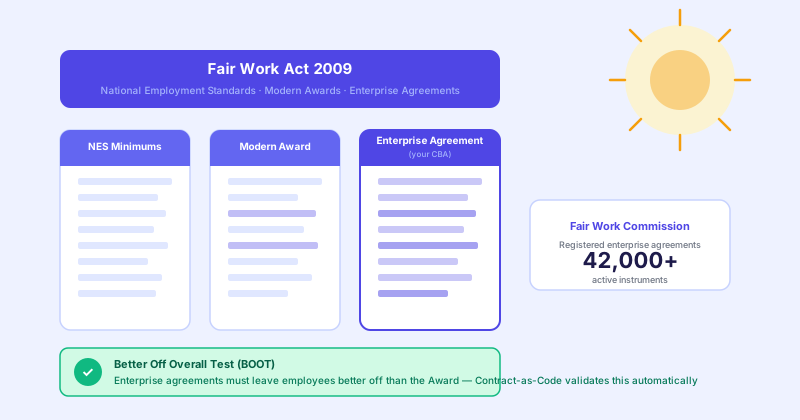
Australia's enterprise bargaining system is one of the most structured in the world. The Fair Work Act 2009 (Cth) creates a layered compliance framework: National Employment Standards (NES) at the base, a Modern Award in the middle, and an enterprise agreement on top — which must leave employees better off than the Award would.
That last requirement — the Better Off Overall Test (BOOT) — is where most compliance complexity lives.
Understanding the three layers
National Employment Standards
The NES establishes 11 minimum entitlements that apply to all national system employees regardless of what any Award or agreement says:
- Maximum weekly hours (38 ordinary hours plus "reasonable additional hours")
- Requests for flexible working arrangements
- Offers and requests to convert casual employment to permanent
- Parental leave and related entitlements
- Annual leave (4 weeks, or 5 weeks for shift workers)
- Personal/carer's leave, compassionate leave, and family and domestic violence leave
- Community service leave
- Long service leave
- Public holidays
- Notice of termination and redundancy pay
- Fair Work Information Statement
An enterprise agreement cannot undercut any NES entitlement. This isn't just a compliance point — it's a validity condition. If an agreement purports to exclude an NES entitlement, that clause is void (though the rest of the agreement typically survives).
Modern Awards
Most industries and occupations are covered by a Modern Award. Awards set baseline conditions — minimum wages, penalty rates, allowances, overtime rules, and more — specific to the industry or occupation.
Awards are updated by Fair Work Commission Full Bench decisions, most significantly the annual minimum wage review each July. This creates a moving floor: an enterprise agreement that satisfied the BOOT when approved may fall below Award conditions after a wage decision, creating underpayment exposure.
Enterprise agreements
An enterprise agreement is negotiated between an employer (or employers) and employees (or their bargaining representatives, typically a union). Once approved by the Fair Work Commission, it replaces the applicable Award for the covered employees during its nominal expiry period — which is typically 4 years.
After the nominal expiry date, the agreement continues to operate unless terminated or replaced. Many employers are still operating under agreements that expired years ago, with wage rates that have fallen significantly below Award rates when adjusted for annual increases.
The Better Off Overall Test
The BOOT is the Fair Work Commission's gateway check before approving an enterprise agreement. The FWC must be satisfied that each award-covered employee (and each class of award-covered prospective employee) would be better off overall under the agreement than under the Modern Award.
The "overall" framing is important. The FWC performs a global assessment — it doesn't require every single condition to be better, just that the overall package is more beneficial. In practice, most agreements compensate for lower penalty rates with a higher base rate or consolidated allowances.
The challenge is demonstrating this mathematically. If your enterprise agreement has 47 separate pay conditions, showing that a part-time nurse working rotating shifts with weekend penalties would be better off requires a detailed modelling exercise against the applicable Award.
BOOT and annualised salary arrangements
Many enterprise agreements implement annualised salary clauses for certain employee categories. An employee receives a flat annual salary in exchange for all overtime, penalty rates, and allowances they would otherwise receive.
The Fair Work Act (Part 2-2, Division 5) now requires employers with annualised salary arrangements to:
- Record the maximum ordinary hours and overtime hours in the agreement
- Conduct an annual reconciliation comparing actual pay to what the employee would have received under the Award
- Backpay any shortfall identified in the reconciliation within 12 months
The annualised salary reconciliation is a significant payroll compliance task that many organisations are not running at the required frequency. Contract-as-Code can validate whether your reconciliation methodology matches the agreement and Award requirements.
Where payroll configurations fail
Penalty rates after Award variations
Fair Work Commission determinations change penalty rates. The Hospitality Industry (General) Award 2020, the General Retail Industry Award, and others have had penalty rates varied through Commission decisions. If your enterprise agreement incorporates Award penalty rates by reference, those rates changed when the Award changed. Most payroll systems don't automatically pick this up.
Allowances that haven't kept pace
Expense-related allowances (tool allowances, vehicle allowances, meal allowances) are typically indexed to CPI or updated by Commission determination. Agreements often incorporate Award allowance rates by reference, which means the payable amount changes each year. Static payroll configurations become non-compliant over time.
Casual loading and conversion
The NES now includes a pathway for casual employees to request conversion to permanent employment after 12 months. Enterprise agreements can have different conversion provisions — more generous ones are permissible, less generous ones are not. Payroll systems often don't track eligibility for conversion, creating administrative risk.
Overtime: daily vs. weekly triggers
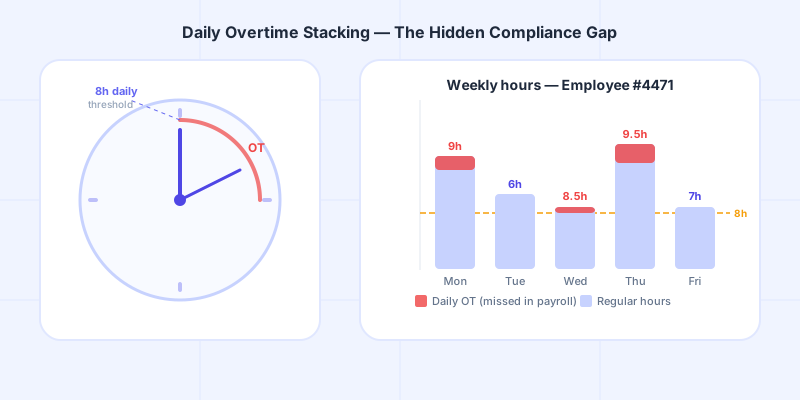
Under many Awards and enterprise agreements, overtime is triggered both by daily thresholds (e.g., after 8 ordinary hours in a day) and weekly thresholds (e.g., after 38 ordinary hours in a week). The daily trigger is frequently omitted from payroll configurations. An employee who works 10 hours on Monday and then a normal week should receive 2 hours of overtime on Monday regardless of their weekly total — many systems miss this.
Part-day public holidays
Following the Full Bench decision in CFMMEU v OS MCAP Pty Ltd 2023, part-day public holidays became a significant compliance issue for employers using continuous shift arrangements. If a public holiday falls on a rostered shift that spans midnight, employees may be entitled to penalty rates for the public holiday portion of the shift. Enterprise agreements that predate this decision may need to be read in light of it.
Practical validation approach
For employers with enterprise agreements, a systematic compliance review involves:
- Agreement audit: Map every monetary entitlement in the agreement (rates, allowances, penalties, overtime, leave loading) to specific clauses.
- Award comparison: Compare each entitlement to the current Award equivalent, noting where the agreement is better, equivalent, or potentially lower.
- Dataset validation: Run payroll data against the agreement rules to identify employees not receiving their correct entitlements.
- Reconciliation: For annualised salary arrangements, conduct the required annual reconciliation.
Contract-as-Code automates steps 1 and 3 by extracting rule structures from your enterprise agreement text and validating your payroll dataset against them. The AI surfaces likely compliance issues; your HR and payroll team reviews and acts on findings.
Contract-as-Code is available for Australian employers with enterprise agreements registered with the Fair Work Commission. All data is stored and processed in Australia Southeast 1 (Sydney). Privacy Act 1988 (Cth) compliant. Not legal advice — all findings require review by qualified workplace relations counsel.