The Working Time Regulations 1998 (WTR) implement the EU Working Time Directive into UK law and remain in force post-Brexit with amendments under the Employment Rights (Amendment, Revocation and Transitional Provision) Regulations 2023. For HR professionals managing collectively agreed workforces, the WTR is a framework of statutory minimums — but collective agreements can modify nearly every provision.
That flexibility is also where compliance risk lives.
The statutory baseline
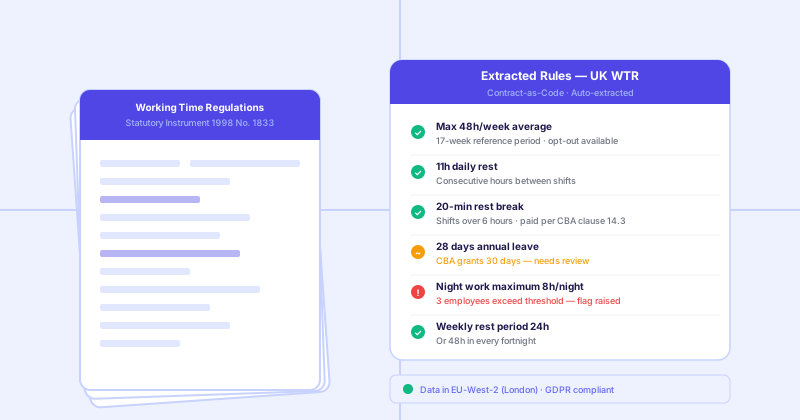
The WTR establishes the following minimum entitlements:
- Maximum working week: 48 hours per week, averaged over a 17-week reference period
- Daily rest: 11 consecutive hours between working days
- Weekly rest: 24 uninterrupted hours per week (or 48 hours per fortnight)
- Rest breaks: 20 minutes for shifts exceeding 6 hours
- Night work limit: 8 hours in any 24-hour period (averaged over 17 weeks for most workers)
- Annual leave: 28 days (5.6 weeks), including bank holidays
Most of these can be modified — either through an individual opt-out (for the 48-hour maximum), or through a collective or workforce agreement.
What collective agreements can modify
Under Regulation 23 of the WTR, collective agreements can modify or exclude several key provisions:
Reference period for the 48-hour average: The default 17-week period can be extended up to 52 weeks. This is common in industries with highly seasonal demand — retail, agriculture, hospitality. If your CBA extends the reference period, the compliance calculation changes significantly.
Daily and weekly rest: The daily 11-hour rest and weekly 24/48-hour rest can be excluded for certain worker categories (shift workers, workers splitting activities across different parts of the day) or replaced with "compensatory rest". If a CBA does this, the compensatory rest entitlement must be explicitly tracked.
Rest breaks: The nature, duration, and when rest breaks must be taken can all be modified by collective agreement. Some agreements provide a paid 30-minute break for shifts over 5 hours; others specify unpaid breaks of different durations at different shift lengths. This variation is frequent and often misconfigured in payroll systems.
Night work: The 8-hour average limit for night workers can be excluded for workers where work involves "special hazards or heavy physical or mental strain" if the CBA permits it. Hazard pay provisions often accompany these exclusions.
Annual leave: the most common misconfiguration
The WTR's 28-day minimum is a floor, and collective agreements routinely grant more — typically 30, 33, or even 35 days for senior grades or long-serving employees. The entitlement amount is usually not where problems arise.
The complexity is in how leave accrues and how it interacts with pay.
Holiday pay and the Supreme Court's Brazel ruling
The Supreme Court's ruling in Harpur Trust v Brazel 2022 UKSC 21 confirmed that for workers with irregular hours, the WTR does not permit a proportionate accrual approach that caps holiday pay at 12.07% of earnings. Workers engaged on a term-time or irregular basis must receive 5.6 weeks' pay calculated on their normal week's pay.
Many CBAs predating this ruling have holiday pay provisions that are now non-compliant. This is an active audit risk — HMRC and employment tribunals have been active in this area.
Leave and sick leave interaction
Statutory annual leave accrues during sick leave. Many CBAs have provisions about contractual leave during absence that are more generous than the statutory baseline, or that specify different rules for different categories of sick leave. Payroll systems often do not track this interaction correctly.
Rolled-up holiday pay
Rolled-up holiday pay (including a percentage uplift in each pay packet rather than paying leave separately) was ruled unlawful by the ECJ for EU member states before Brexit. Post-Brexit amendments to the WTR introduced by SI 2023/1341 have re-permitted rolled-up holiday pay for irregular-hours workers, but with specific calculation requirements. If a CBA has a rolled-up pay provision, its validity depends on when it was agreed and which worker category it applies to.
Night worker health assessments
If your CBA covers night workers, Regulation 7 requires that you offer a health assessment before the worker commences night work, and repeat it at regular intervals. This is frequently overlooked in the compliance review process — it falls between HR, occupational health, and payroll without a clear owner.
CBAs often specify the frequency of assessments. Non-compliance creates employment tribunal exposure.
The opt-out and its limits
The 48-hour opt-out allows individual workers to agree in writing to exceed the maximum. But the opt-out cannot waive all WTR protections — daily rest, weekly rest, and rest breaks remain in place. Some HR teams mistakenly treat a signed opt-out as eliminating all WTR scheduling obligations, which it does not.
Collective agreements can restrict the use of opt-outs, or require union consultation before opt-outs are offered to members. If a CBA has such provisions, you need to track whether opt-out processes comply.
What AI-assisted rule extraction surfaces
Contract-as-Code processes your collective agreements and identifies WTR-relevant provisions: modified reference periods, compensatory rest provisions, rest break specifications, holiday entitlement grades, leave accrual rules, and night work clauses. Each is surfaced as a rule candidate for HR review before it enters the validation pipeline.
Validation then runs against your payroll data to identify employees whose recorded working time, rest periods, or holiday pay may not match the agreement and statutory requirements.
Contract-as-Code is available for UK employers. All data is stored and processed in EU-West-2 (London). Compliant with UK GDPR and the Data Protection Act 2018. Not legal advice — always review findings with qualified employment law counsel.