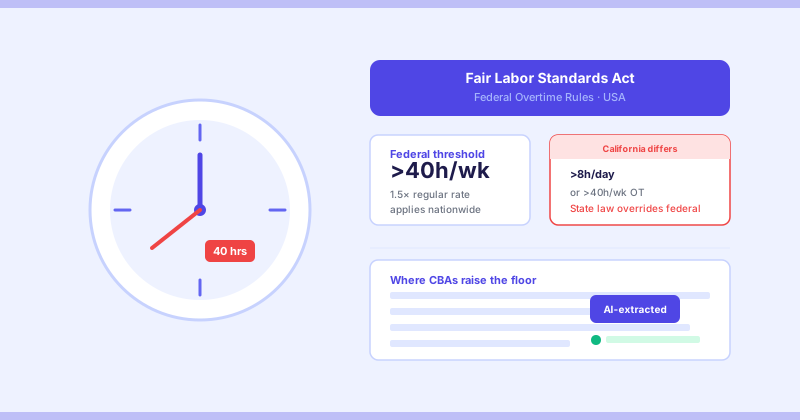
The Fair Labor Standards Act's overtime provision is deceptively simple: pay 1.5× regular rate for hours worked beyond 40 in a workweek. Most HR professionals know this. Most payroll systems implement it. And yet, overtime compliance remains one of the most litigated areas of US labor law.
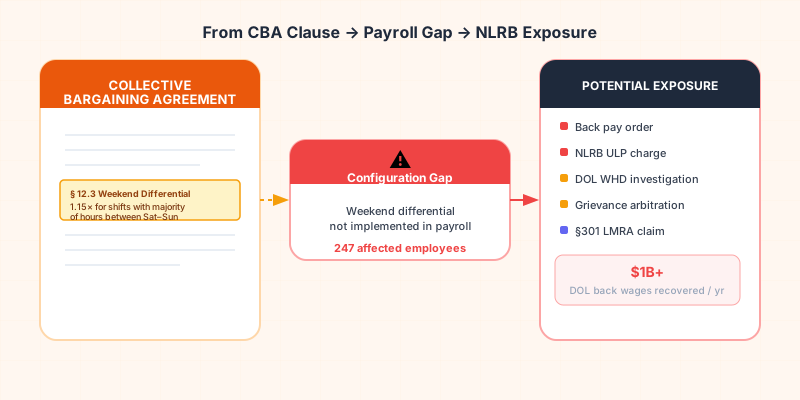
The reason? The FLSA sets a floor — not a ceiling. Collective bargaining agreements routinely raise that floor in ways that are operationally complex and frequently misconfigured.
What the FLSA actually requires
Under 29 U.S.C. § 207, covered non-exempt employees must receive overtime pay for hours worked over 40 in a single workweek. The "workweek" is a fixed, regularly recurring 168-hour period — which is not necessarily Monday through Sunday. How you define the workweek affects overtime calculations, and CBAs sometimes establish different workweek definitions for different bargaining units.
The regular rate of pay — the base for calculating 1.5× — is also more complex than it appears. It must include:
- Hourly earnings
- Non-discretionary bonuses
- Shift differentials
- On-call pay
- Piece-rate earnings
Discretionary bonuses, gifts, and certain other payments are excluded. CBAs often introduce compensation elements that require careful classification.
Where state law complicates things further
For US employers operating in California, New York, or Alaska, the federal 40-hour weekly threshold is only part of the picture.
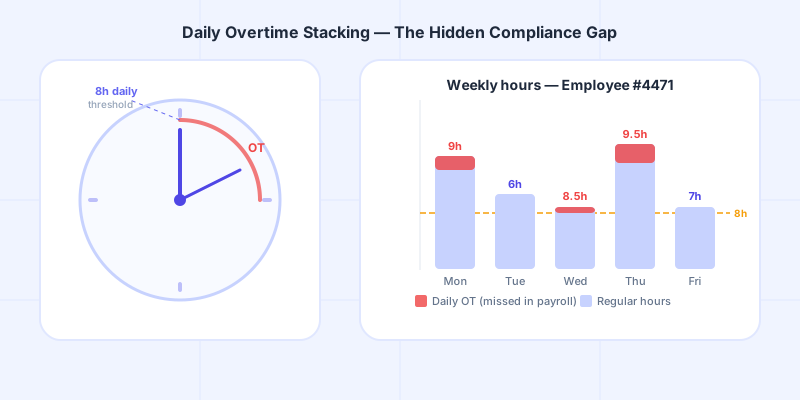
California requires daily overtime: 1.5× for hours over 8 in a day, 2× for hours over 12 in a day, and 1.5× for the first 8 hours worked on the seventh consecutive day in a workweek. This applies to non-exempt employees regardless of how many weekly hours they work.
Alaska requires daily overtime for hours over 8 in a day.
New York has industry-specific rules for hospitality workers, residential employees, and others.
If a CBA covers employees working across these states, jurisdiction selection at validation time is critical — the same hours can trigger overtime in California that wouldn't trigger it at the federal level.
How CBAs raise the floor
Here are the most common ways collective bargaining agreements expand overtime obligations beyond the FLSA minimum:
Daily overtime in states that don't require it
A CBA negotiated in Ohio or Texas may grant daily overtime — time and a half after 8 hours per day — even though neither state requires it. When this provision exists in the agreement, you are contractually obligated to pay it. Payroll systems configured only for FLSA compliance will miss it.
Overtime after fewer weekly hours
Some agreements set a lower overtime trigger: 37.5 or 35 hours per week. This is common in certain public sector bargaining units and professional healthcare contracts. Employees hit overtime at hour 38 when payroll calculates it starting at hour 41.
Pyramiding prohibitions
Many CBAs include anti-pyramiding language: a rule that prevents the same hours from being counted twice for overtime purposes. This sounds protective but has a practical implication — you need to know which premium payment wins when multiple entitlements apply to the same hours.
Shift length guarantees affecting overtime calculation
If a CBA guarantees a minimum paid shift — say, 4 hours when an employee is called in — those guaranteed hours count toward overtime even if the employee only physically worked 2 of them. This is a common source of underpayment.
Premium rates for overtime on premium hours
Some agreements specify that overtime worked during premium hours (holidays, nights, weekends) is paid at 2× or 2.5× rather than 1.5×. Payroll systems often apply FLSA's 1.5× as a cap, not a floor.
The translation problem
The gap between FLSA compliance and CBA compliance is a translation problem: the obligations are written in natural language in a PDF, and payroll systems operate on structured logic.
Until recently, the only way to bridge that gap was a manual review process: HR or labour relations staff reading through agreement language and manually configuring payroll rules. This is expensive, error-prone, and doesn't scale to organizations with multiple bargaining units.
Contract-as-Code's AI pipeline extracts overtime rule structures — thresholds, rates, triggers, anti-pyramiding clauses, shift guarantees — directly from agreement text and validates your payroll data against them. Each rule candidate is surfaced for human review before it becomes active. You retain decision authority; the AI handles the translation work.
What to look for in your agreements
If you're doing a manual audit, start with these sections:
- Article on hours of work — Look for definitions of the normal workday and workweek, any daily overtime provisions, and minimum shift guarantees.
- Overtime article — Note the trigger hours, the rate, and any rules about which hours qualify.
- Premium pay article — Look for provisions that apply premiums to overtime hours specifically, or that specify how overlapping premiums interact.
- Scheduling provisions — Unusual scheduling arrangements (compressed work weeks, shift rotations) often have their own overtime rules.
- Anti-pyramiding language — Usually near the overtime article. Note how it interacts with daily overtime provisions if both exist.
Contract-as-Code is available for US employers managing NLRA-governed CBAs. Data is stored and processed in US infrastructure (us-central1 / us-east-2). Not legal advice — all findings require human review.