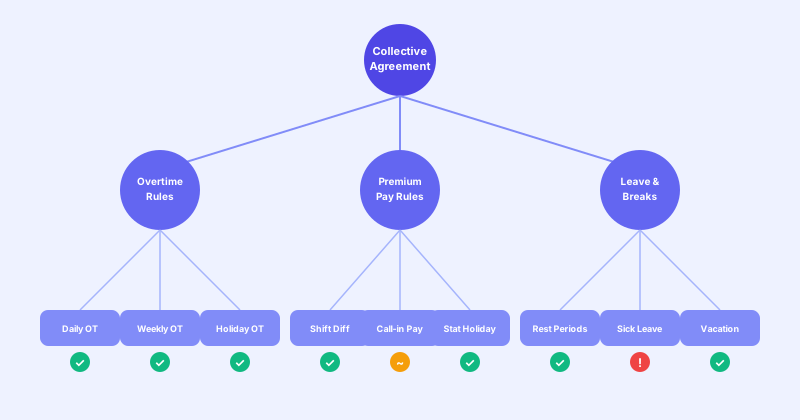
After processing collective agreements across healthcare, manufacturing, construction, and public sector bargaining units, we've identified consistent patterns in where compliance gaps occur. The same six rule families account for the overwhelming majority of payroll validation findings.
Understanding where agreements are most commonly misconfigured is the first step to fixing the translation problem.
1. Overtime — thresholds and multipliers
The gap: Most provinces have Employment Standards Act minimums for overtime (44 hours/week in Ontario, 40 hours in BC). Many collective agreements provide a higher standard — 37.5 or 40 hours — but payroll systems are often configured to the ESA minimum, not the CBA standard.
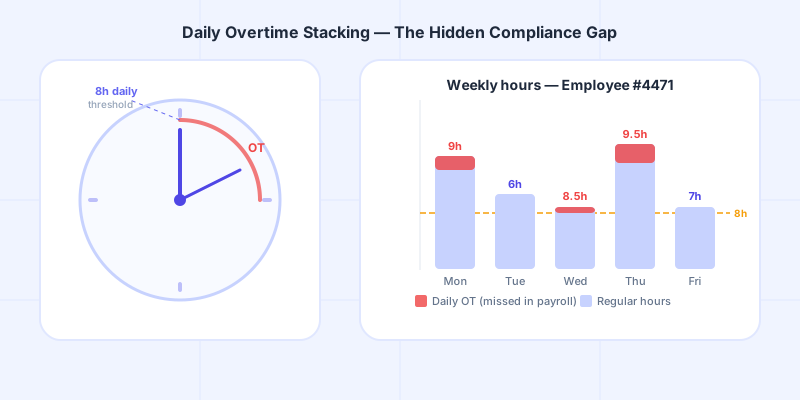
What to look for: Agreements often have both a daily threshold (7.5 hours) AND a weekly threshold (37.5 hours), with the employee entitled to overtime pay if either is exceeded. Payroll systems frequently implement only the weekly threshold.
Common phrase: "All hours worked in excess of threshold per day or threshold per week shall be compensated at multiplier times the employee's regular rate."
The multiplier: Most agreements specify 1.5×. Some specify 2× after a second threshold (double-time). The triggers for each multiplier need to be captured separately.
2. Shift premiums — evening and night differentials
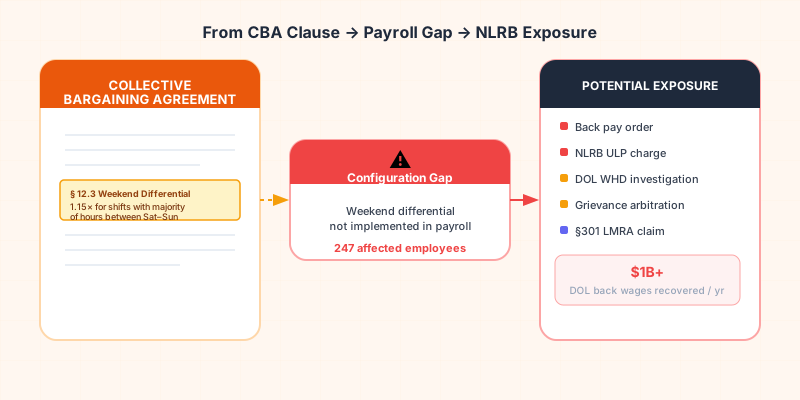
The gap: Shift premium rules are highly specific about the time windows that qualify for a premium. "Evening shift" in one agreement might mean shifts starting after 15:00; in another, it might mean shifts where the majority of hours fall between 15:00 and 23:00. These distinctions matter enormously.
What to look for:
- Exact time boundaries for each premium tier
- Whether the rule applies based on shift start time, shift end time, or the majority of hours worked
- Whether the premium applies to the whole shift or only to the hours that fall within the premium window
- Whether shift differentials stack with overtime pay
Common phrase: "Employees working a shift where the majority of hours fall between start and end shall receive a shift premium of $X.XX per hour."
Healthcare-specific: On-call and callback premiums are often separate from shift premiums, with different calculation bases and minimum call guarantees.
3. Vacation entitlement — years of service tiers
The gap: Vacation entitlement typically increases with years of service, but the thresholds are negotiated in each agreement. The ESA minimum (2 weeks after 1 year; 3 weeks after 5 years in Ontario) is rarely what the CBA provides.
What to look for:
- Exact years-of-service thresholds for each vacation tier
- Whether "years of service" is measured from hire date, from the date of joining the bargaining unit, or from some other reference date
- Whether the entitlement is to weeks of vacation time, a percentage of annual wages, or both (whichever is greater)
- Whether the agreement distinguishes between vacation time accrual and vacation pay
Common phrase: "An employee shall be entitled to vacation with pay as follows: after X years of continuous service — Y weeks at Z% of annual wages."
The continuous service issue: Breaks in service (leaves, temporary layoffs) may or may not reset the service clock, depending on the agreement. This is a common source of findings.
4. Wage rates and classifications
The gap: Agreements typically have wage grids organized by classification and step. The classification of an employee in the payroll system must match the classification in the agreement's wage schedule. Misclassification — even by one step — creates systematic underpayment.
What to look for:
- Classification definitions (which roles qualify for which classification)
- Step progression rules (is progression automatic on anniversary date? Subject to satisfactory performance review?)
- Whether there are separate rates for probationary employees
- Wage reopener clauses or economic adjustments that apply mid-agreement
Common phrase: "The wage schedule at Schedule A forms part of this Agreement. Employees shall be paid in accordance with their classification and the applicable step on the wage grid."
The out-of-scope work premium: Many agreements include a premium for employees temporarily performing work outside their classification, particularly when performing higher-rated work. These are frequently missed.
5. Termination — notice and severance
The gap: CBA termination provisions often provide more than the ESA minimum. The calculation of notice pay can be complex, particularly for long-service employees, and the interaction between CBA entitlements and ESA entitlements is a recurring source of error.
What to look for:
- CBA notice periods vs. ESA minimums — which applies?
- Whether the agreement provides for severance pay separate from notice
- Recall rights — how long must employees remain on a recall list?
- Whether termination provisions vary by reason for termination (layoff vs. cause)
Limitation: This rule family involves significant legal judgment. Our AI extraction can identify the relevant clauses and flag potential discrepancies, but termination decisions require legal counsel review before any action is taken.
6. Grievance procedures
The gap: Grievance timelines are strictly enforced in arbitration. If a grievance must be filed within 10 days of the event and an HR team misses that window, the grievance right may be forfeited — or conversely, if an employer fails to respond within the required timeline, the grievance may be deemed upheld by default.
What to look for:
- Step-by-step timelines at each stage of the grievance procedure
- Whether the timeline is calendar days or working days
- Whether there are different timelines for different types of grievances (individual vs. policy vs. group)
- Extension provisions — under what circumstances can timelines be extended, and who must agree?
Practical note: Grievance procedure tracking is a workflow and HR system problem more than a payroll problem. The AI extraction helps identify what the timelines are; the process of tracking whether those timelines are met requires HR workflow tooling.
The common thread
What makes these six families difficult isn't that the rules are complex in isolation — it's that they interact. An employee working overtime on a night shift is entitled to both overtime pay and a shift premium. The calculation of one affects the base for the other. A long-service employee on a recall list still accrues vacation. These interactions are where manual translation breaks down fastest.
Structured rule extraction — combined with human review — helps surface these interdependencies before they become findings.
Not legal advice. Contract-as-Code provides operational decision support tools for HR and payroll professionals. Always review findings with qualified legal, HR, or payroll counsel before taking action.