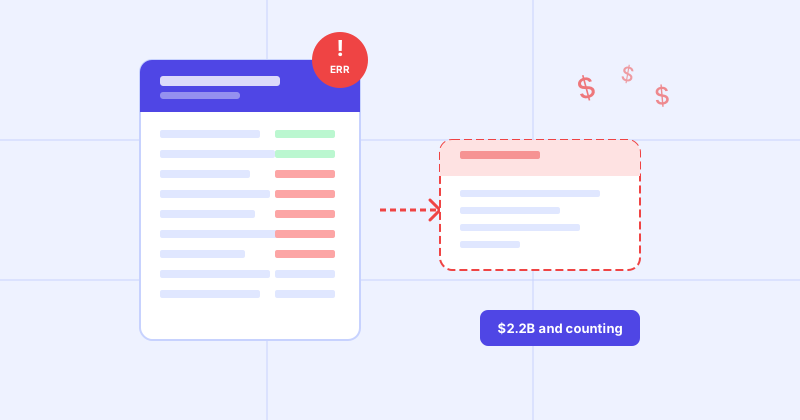
Canada's Phoenix Pay System failure is now officially a $2.2 billion problem. But most discussions focus on what went wrong with the federal government's implementation — not on the underlying structural issue that Phoenix revealed: there is no reliable method for translating collective agreement rules into operational payroll logic at scale.
That problem exists in every organization with a unionized workforce. It's rarely solved, and it never fully goes away.
The translation problem
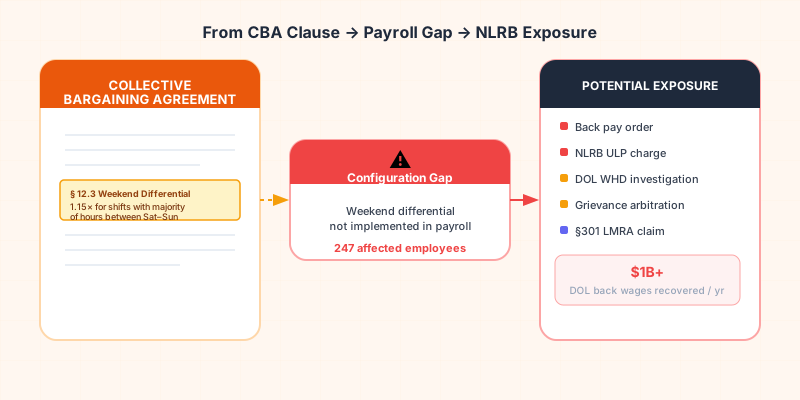
A collective agreement is a legal document. It describes rules in natural language: shift premiums, overtime thresholds, vacation entitlements, grievance procedures. The language is precise but contextual — designed to be interpreted by humans who understand the workplace it governs.
A payroll system is a configuration database. It stores numeric thresholds, rate codes, and processing rules. It doesn't read clauses. It doesn't understand "majority of hours fall between 1500 and 2300."
Between these two worlds is a manual translation step that someone — usually an HR analyst, a payroll specialist, or a consultant — performs by reading the contract and configuring the system. This step is:
- Error-prone: complex agreements have hundreds of interdependent clauses
- Undocumented: the reasoning behind each configuration decision is rarely recorded
- Unverified: there's no standard way to test whether the system correctly implements what the contract says
- Invisible at scale: systematic errors often go undetected until a grievance, an audit, or — in Phoenix's case — a public inquiry
What Phoenix actually demonstrated
The public narrative around Phoenix focused on the IT project management failures — the rushed implementation, the inadequate testing, the ignored warnings. Those are real. But they obscure a deeper problem.
Even a well-implemented pay system has no way to automatically verify that its configuration matches what a collective agreement requires. The human translation step is the weakest link — and it happens at every collective agreement renewal, every Letter of Understanding amendment, and every time a new bargaining unit is added.
Organizations with dozens of collective agreements face this problem dozens of times, perpetually.
The cost of a 0.1% error rate
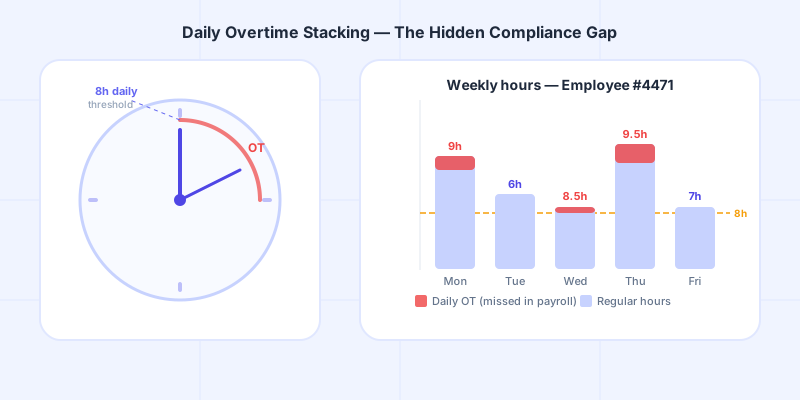
Consider a mid-size healthcare organization with 5,000 unionized employees and an average hourly rate of $35/hour. A 0.1% systematic error in overtime calculation — say, applying a 44-hour threshold when the collective agreement specifies 37.5 — affects every employee who works more than 37.5 hours in a week.
If 20% of those employees work overtime in a given pay period, and the average overpayment exposure per employee is $45 per pay period, the annual underpayment liability is approximately $2.3 million — from a single misconfiguration on a single rule.
At 0.1%.
Phoenix had error rates measured in percentage points, across hundreds of thousands of employees, for years.
A better approach
The goal isn't to eliminate human judgment from collective agreement interpretation — that judgment is legally necessary and professionally appropriate. The goal is to:
- Make the translation visible: Extract the rules from the contract text in a structured, reviewable format
- Require human approval: No extracted rule becomes operational without a qualified person reviewing and approving it
- Enable continuous verification: Run validation against actual payroll data regularly, not just after implementation
- Maintain an audit trail: Document every rule decision and every validation finding
This is what Contract-as-Code is built to do. Not to replace HR and legal judgment — but to give HR and legal professionals a structured tool for exercising that judgment, and verifying it against real data.
The compliance gap isn't a technology problem
It's a process problem. And process problems don't get solved by better software alone — they get solved by building better processes around better software.
The question isn't "did Phoenix's software work?" The question is: "did anyone verify, at any point, that the system's configuration matched what the collective agreements required?"
For most organizations, the honest answer is: not systematically, not continuously, and not in a way that would have caught a 0.1% error before it became a $2.2 billion one.
Not legal advice. Contract-as-Code provides operational decision support tools for HR and payroll professionals. Always review findings with qualified legal, HR, or payroll counsel before taking action.